

The Art of Listening
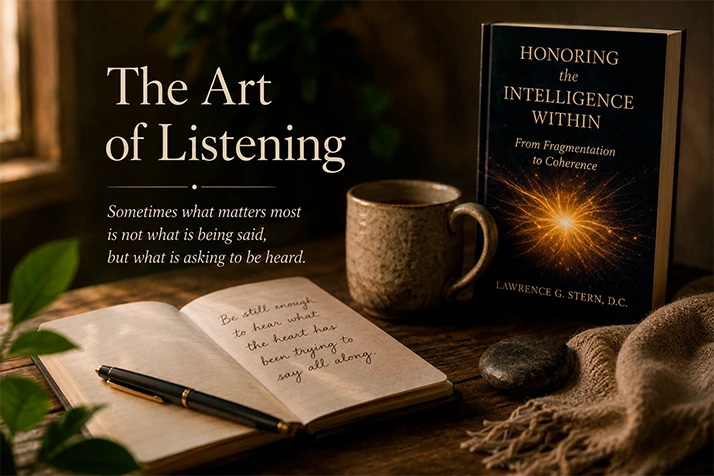
Sometimes what matters most is not what is being said, but what is asking to be heard.
One of the greatest gifts we can offer another human being is not advice.
It is our presence.
Most of us have learned how to listen to words. Yet how often, while another person is speaking, are we already preparing our response? Thinking about what we might say next? Searching for the solution we can offer?
We hear the words.
But sometimes we miss what the words are trying to reveal.
Over more than four decades of caring for people, I have come to understand that there is another kind of listening.
A quieter kind.
One that asks less of our intellect and more of our presence.
It is the art of listening beneath the story.
What Lives Beneath the Words
People arrive in my office with stories.
“My neck hurts.”
“I can’t sleep.”
“I’ve been under tremendous stress.”
“I just don’t feel like myself anymore.”
Those words matter. They deserve to be heard.
But they are rarely the whole story.
Because beneath every symptom there may be an adaptation.
Beneath every adaptation is a nervous system responding to the experiences and demands of a life.
And beneath those protective patterns is an intelligence that has never stopped working on our behalf.
This changed the way I learned to listen.
Instead of asking only, What is wrong?
I became increasingly curious about another question:
What might this person’s nervous system be trying to communicate?
That is a very different conversation.
The Body Has Its Own Language
As chiropractors, we are trained to observe posture, movement, spinal function and patterns of tension.
Early in my career, I understood many of these observations primarily through a mechanical lens.
Over time, that changed.
I began to recognize that the body in front of me was not simply a collection of muscles, joints and vertebrae.
It was a person.
A history.
A lifetime of experiences, relationships, challenges, adaptations, losses, joys, fears and possibilities—all expressed, in some way, through a living nervous system.
The body is always communicating.
Sometimes through movement.
Sometimes through tension.
Sometimes through breath.
Sometimes through stillness.
And sometimes through a symptom that has become impossible to ignore.
The question is whether we are willing to listen.
Listening Without Rushing to Fix
There is something deeply human about wanting to help.
Someone tells us they are hurting and we want to make the hurt disappear.
Someone is struggling and we search for the right advice.
Someone comes to us with a problem and we immediately begin looking for the solution.
I understand that impulse. I have lived it.
But meaningful care has taught me something different.
Sometimes our desire to fix can prevent us from fully seeing the person standing before us.
True listening asks us to resist that urgency, if only for a moment.
To become curious before becoming corrective.
To observe before interpreting.
To listen before deciding.
And to recognize that the person before us may possess an intelligence and capacity for change far greater than we realize.
Listening Beyond Our Ears
True listening extends beyond hearing.
We listen with our eyes.
With our hands.
With our attention.
With our intuition.
With our willingness to notice the subtle changes that occur when another human being begins to feel genuinely seen.
In my work with Network Spinal, this kind of listening has become inseparable from care.
A change in breathing.
A softening of tension.
A subtle shift in posture.
A movement that wasn't there moments before.
These may seem like small things.
But sometimes the smallest changes tell us that something within the nervous system is beginning to reorganize.
The practitioner does not need to force that conversation.
We need to become quiet enough to notice it. To become one with it.
The Experience of Being Understood
There is another dimension to listening that extends far beyond the chiropractic office.
Think about the people in your own life.
How many conversations are really exchanges of opinions?
How often do we listen in order to respond rather than listen in order to understand?
And how different does it feel when someone gives us their complete attention?
No judgment.
No interruption.
No immediate solution.
Just presence.
Something changes.
We soften.
We breathe.
Perhaps, for a moment, we no longer feel the need to defend or explain ourselves.
We simply feel seen.
There is something profoundly healing about that experience.
Listening Beneath the Story
I once believed that being a good doctor meant having answers.
Experience has taught me that sometimes the more important skill is learning how to ask better questions—and becoming quiet enough to hear the response.
Not only the response spoken in words.
But the responses expressed through the body.
Through breath.
Through movement.
Through emotion.
Through silence.
Perhaps this is what it means to listen beneath the story.
To recognize that behind every symptom is a person.
Behind every person is a history.
And within every history is an intelligence that has been adapting, protecting, learning and searching for a way forward.
Our responsibility is not always to provide the perfect answer.
Sometimes the greatest gift we can offer another human being is something much simpler.
To be present.
To become curious.
To listen.
And, perhaps most importantly, to allow another person the experience of being profoundly understood.

OFFICE HOURS
Monday
9:30am - 1:00pm
3:00pm - 7:00pm
Tuesday
3:00pm - 7:00pm
Wednesday
9:30am - 1:00pm
3:00pm - 7:00pm
Thursday
Closed
Friday
9:30am - 1:00pm
3:00pm - 7:00pm
Saturday
9:30am - 1:00pm
Sunday
Closed

Stern Chiropractic Integrative Wellness, P.C.
121 Smith Ave
Mt Kisco, NY 10549